
6th September 2024
What’s an EU policy geek and former civil society leader doing at Europe’s largest gathering of sociologists? It’s a question I asked myself more than once.
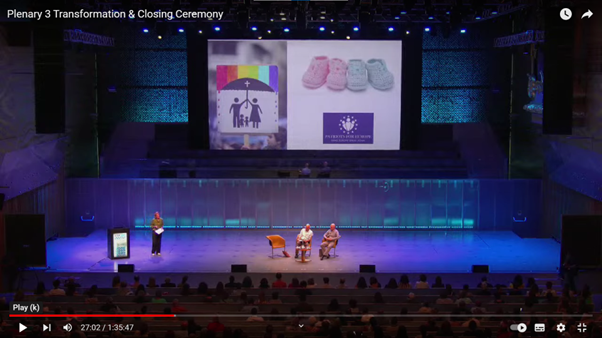
I had been invited to deliver a keynote address at the closing plenary, choosing the rather broad topic of “Science, Politics, and Activism.” I focused on the evolution of EU policy on children’s rights in recent years, the factors driving these changes, and the challenges ahead.
The event drew nearly 4,000 researchers, from every stage of the academic career. In some sessions almost 100 workshops were running in parallel, showcasing the incredible diversity of research, inquiry, and collaboration.
I barely scratched the surface of the conference content but came away with many new insights. For example, Manuela Boatcă’s fascinating research on the enslavement of Romani populations across Europe provides an important perspective for understanding the ongoing marginalization and oppression of Roma communities today.
In a session on poverty and its impact on mothers, children, and families, a researcher shared her findings on forced adoptions in Denmark. Following a 2023 legal reform designed to offer vulnerable children stable homes as early as possible, the number of forced adoptions has increased. The research shows that this increase is concentrated in just a few municipalities. She also referred to some families migrating to neighboring countries to avoid separation.
The main message of my speech, reinforced by my experience in Porto, was that sociological research is too important to remain within academic circles. In today’s tense social and political environment, scholarship without activism feels pointless, even indulgent. Effective policies must be grounded in evidence, and partnerships between academia and civil society can ensure that research influences policymaking.
I also highlighted children and young people’s crucial role in driving change. This builds on the themes of empowerment, co-production, and the value of lived experience—topics that were often repeated throughout the conference.
But reflecting on my time in Porto, I cannot avoid mentioning the battleground of gender. I shared the stage with Professor Biggs, a controversial figure some label as transphobic. He spoke on queer theory, critiquing the shift in English prisons from sex-based to gender-based categorizations—a shift influenced by sociologists and philosophers like Judith Butler. I am unfamiliar with the arguments and individuals involved, but the tension in the room was palpable. For many, simply allowing Professor Biggs to speak was offensive.
The topic of so-called “gender ideology” also came up in my presentation. I addressed it in the context of anti-gender movements that threaten progress on children’s rights and child protection. These movements, rooted in fears about the decline of the ‘traditional family,’ campaign based on ideology rather than on evidence of what children need to thrive.
It struck me as ironic that the debate over sex and gender dominated the closing plenary dedicated to the topic of ‘transformation’. Both sides, in my view, have legitimate concerns. Yet, because these issues touch on identity and personal integrity, the positions are deeply polarized and appear mutually exclusive.
I left Porto with mixed feelings. On the one hand, I am more convinced than ever of the importance of sociological research in uncovering social injustice and driving societal change. On the other hand, it’s clear that no sector is immune to ideological divides. Even academia, driven by data, evidence and critical thinking, can be sucked into binary arguments when the research touches upon identity and belonging.